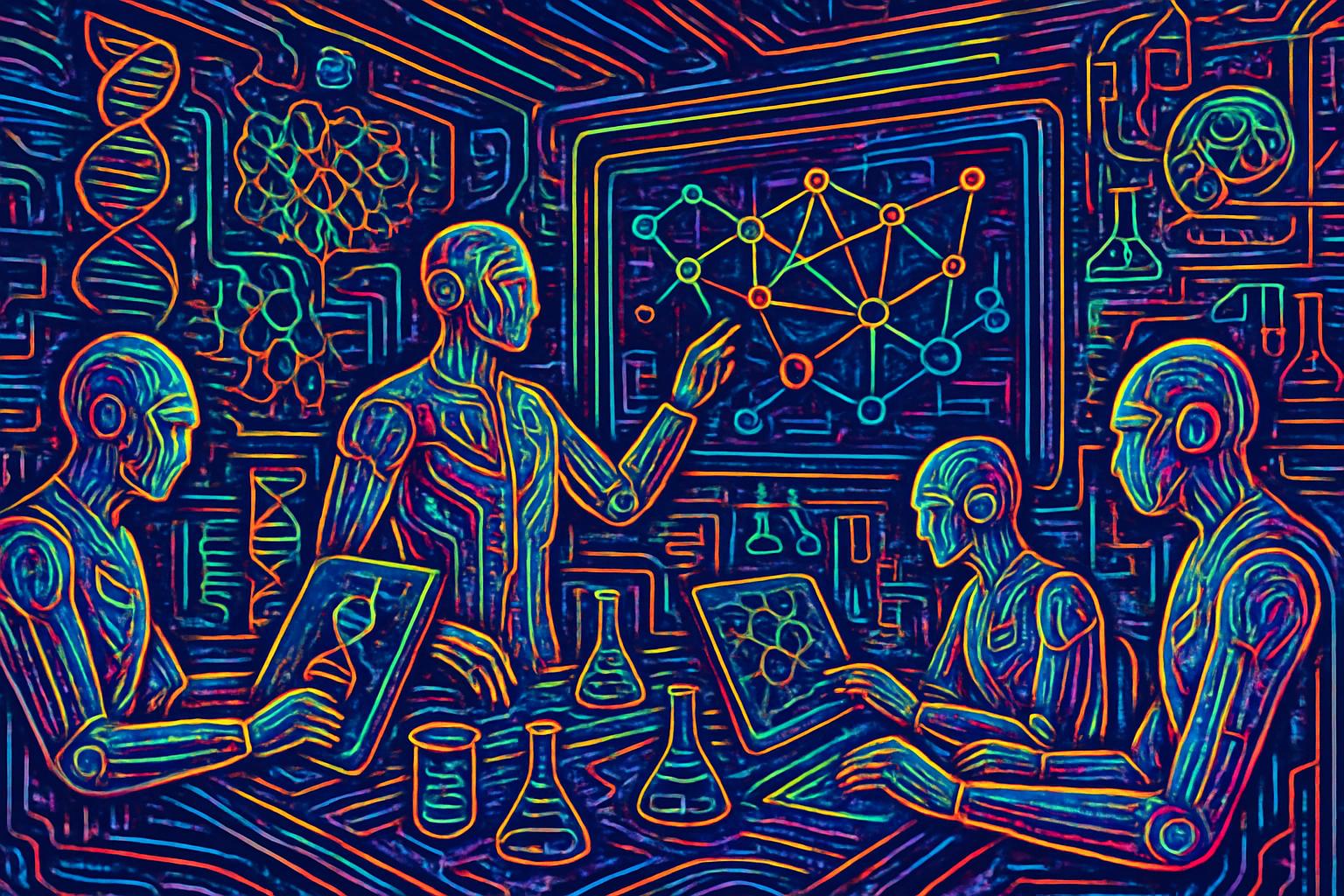
What happens when machines don’t just follow commands but start acting like researchers, brainstorming, critiquing, and innovating? Could virtual scientists offer a faster, smarter path to solving biological challenges?
Researchers create ‘virtual scientists’ to solve complex biological problems, published by Stanford Medicine, discusses how artificial intelligence is reshaping scientific research. A Stanford team developed a virtual lab composed of AI agents that simulate the roles of expert scientists, tackling biological challenges with reliable efficiency. These virtual scientists can process information, share ideas, and critique each other’s work, reflecting the dynamics of a human research team.
One of their initial accomplishments involved designing a potential vaccine for SARS-CoV-2 variants. The virtual lab relied on a different approach, focusing on nanobodies—smaller and simpler fragments of antibodies—which were shown to bind more effectively to virus variants in laboratory tests. This work highlights how AI can address biological questions in ways that human teams may not immediately consider. The entire process operates with minimal human intervention, yet produces results that are verified in real-world labs.
In addition to addressing specific challenges, these AI agents bring strong analytical capabilities, often uncovering insights that existing human analyses might miss. By reevaluating published research or proposing alternative methods for vaccine development, they demonstrate a capacity to rethink prior knowledge while generating new methods for the future.
Why It’s Significant
This development carries weight because it transforms our understanding of how humans and machines can work together in scientific discovery. The AI-powered lab highlights the efficiency and versatility of language models when applied to medical and biological challenges. Unlike standard automated tools, these AI agents function semi-independently, coordinating to propose and test scientific theories. Early results hint at faster and more flexible approaches to solving urgent problems like vaccine development, potentially speeding up biomedical advancements that could save lives.
Additionally, the ability of these agents to work collaboratively reflects a more sophisticated use of artificial intelligence. They not only gather information but also apply critical thinking—assessing risks, offering inventive approaches, and even critiquing their own outputs in an organized, human-like way. This advanced application broadens the potential for AI systems to support fields that demand high levels of expertise and teamwork.
Advantages
- Speed: AI agents can analyze information and run simulations far faster than traditional lab work, significantly shortening research timelines.
- Efficiency: These virtual systems reduce the workload for researchers by independently testing multiple approaches, allowing labs to focus on ideas with the most promise.
- Creativity: The agents’ ability to think beyond conventional methods, as seen with their choice of nanobodies, paves the way for unique solutions to long-standing problems.
- Accuracy: The integration of tools like AlphaFold enables precise modeling and validation of protein designs, strengthening the credibility of their proposed solutions.
Concerns
While these developments show potential, some challenges persist. One issue involves ensuring these virtual scientists consistently produce outputs that align with real-world biological systems, especially in highly complex scenarios. Overreliance on AI may also risk limiting human ingenuity, as researchers might gradually defer critical thinking. Additionally, initial expenses for creating and operating a virtual lab might discourage institutions with limited budgets.
Possible Business Applications
- Custom Drug Design Platforms: A company could provide personalized AI-driven drug design services to biotech firms, greatly reducing the time and cost of developing new pharmaceutical candidates.
- Reevaluation Services for Research Labs: Startups could offer services reevaluating published research using AI agents, potentially uncovering overlooked findings or alternative perspectives.
- Quick Vaccine Prototyping: A business could specialize in creating AI-powered vaccine discovery pipelines targeting emerging infectious diseases.
The concept of virtual scientists opens a new chapter in exploring how artificial intelligence can assist human innovation. At its foundation, this approach emphasizes the importance of collaboration between humans and intelligent systems, where AI addresses gaps in speed and data processing while humans contribute intuition and ethical judgment. As with any new technology, careful oversight is crucial to ensure that this tool complements rather than replaces human creativity. These developments remind us of the wide-ranging possibilities that emerge at the intersection of human curiosity and advancing technology.
—
You can read the original article here.
Image Credit: GPT Image 1 / Colorful Line Art.
Make your own custom style AI image with lots of cool settings!
—
I consult with clients on generative AI-infused branding, web design, and digital marketing to help them generate leads, boost sales, increase efficiency & spark creativity.
Feel free to get in touch or book a call.