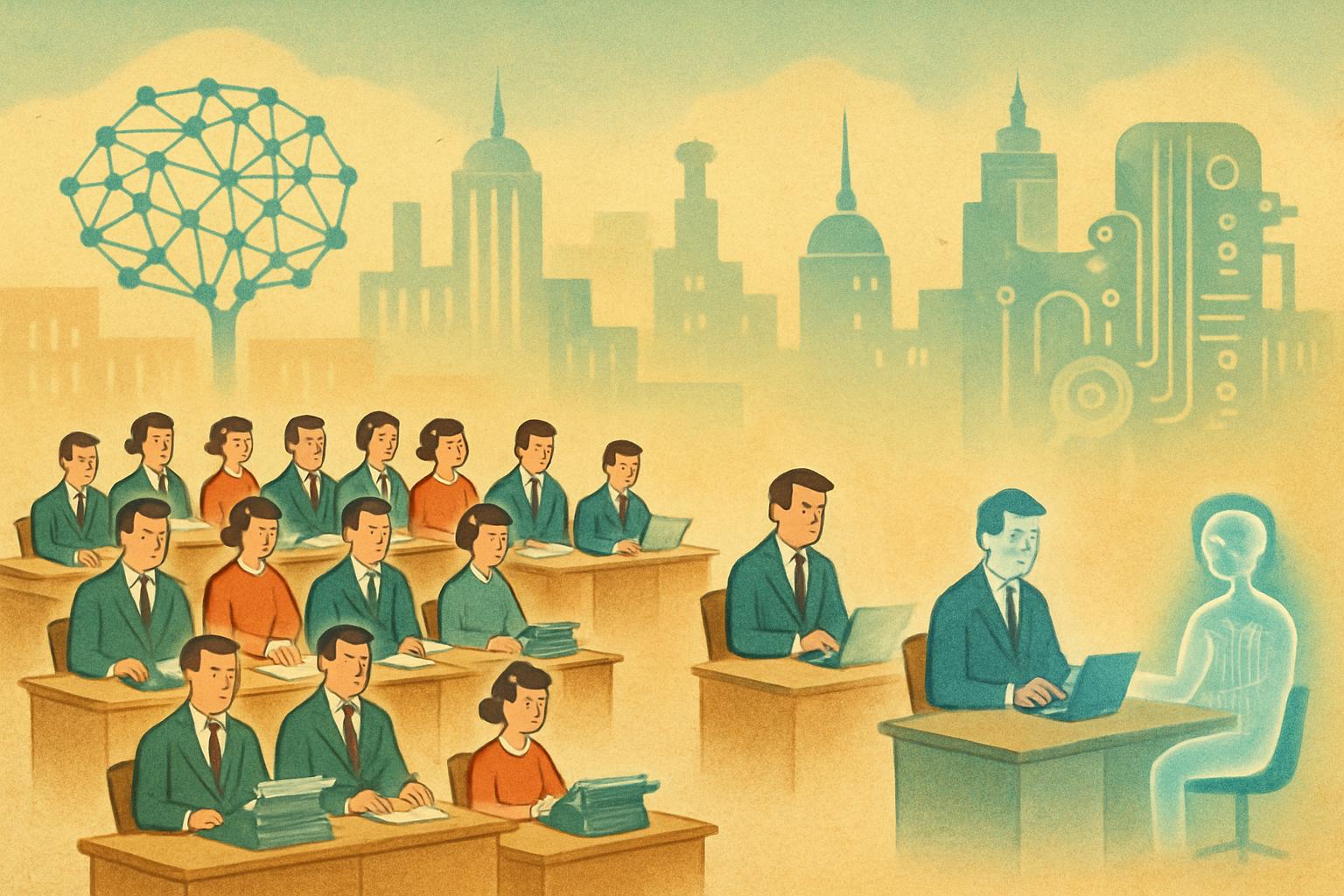
As artificial intelligence reshapes industries, it’s not just machines taking over tasks—it’s entire roles being reconsidered. Jobs once defined by routine are evolving, but not everyone is equally affected. The question we face isn’t just about efficiency, but fairness. How do we adapt to a workforce redefined by technology?
AI Is Going to ‘Replace Everybody’ in Several Fields, According to the ‘Godfather of AI’ examines Geoffrey Hinton’s perspective on the future of artificial intelligence and its potential impact on various industries. Known for his foundational work on neural networks and deep learning, the AI pioneer warns that many jobs, particularly white-collar roles involving repetitive or “mundane intellectual labor,” are at high risk of being replaced. Highlighting examples like paralegals and call center workers, Hinton believes tasks previously handled by teams may soon be managed by an individual working with AI tools. He predicts this shift could lead to notable job displacement across industries.
However, not all occupations are equally at risk. Hinton points out that blue-collar roles, especially those requiring complex physical manipulation, like plumbing, are less likely to be replaced by AI in the near future. He also questions the idea that automation will automatically create new jobs, suggesting most remaining opportunities will demand highly specialized skills beyond the capabilities of AI systems.
The article also touches on broader hiring trends, noting that big tech companies seem to be scaling back on entry-level job opportunities for graduates. For instance, hiring at companies like Meta and Google declined substantially from 2023 to 2024, with one contributing factor being the increased use of AI. Even industries like banking have begun incorporating AI-driven automation, with workforce reductions already evident at prominent financial institutions.
Why It Matters
The changes shown in the article emphasize an important reality: AI isn’t just a tool for efficiency—it’s altering how entire industries function. Hinton’s insights warn of growing challenges for white-collar professions, where repetitive knowledge-based tasks are particularly susceptible. This trend could redefine workplace expectations, modify hiring strategies, and result in large portions of the workforce needing retraining or new career paths. While AI presents effective tools for progress, its ability to combine job roles into fewer hybrid positions signals a tough period of adjustment for numerous industries.
Benefits
AI’s ability to simplify workflows has undeniable upsides. For businesses, it means cost savings, enhanced productivity, and quicker outputs. In sectors like customer service, tools powered by AI can address repetitive requests effectively, freeing human staff to handle more substantive or intricate matters. Companies could redirect resources toward long-term strategic priorities by using automation for routine tasks. For consumers, this often translates to faster responses and an overall better service experience. Additionally, in areas such as healthcare and legal work, AI can support professionals, helping to ensure accuracy and reduce human mistakes.
Concerns
On the other hand, Hinton’s predictions bring up hard questions about potential social and economic consequences. Widespread automation could result in job losses and reduced hiring, especially among younger or entry-level workers. Furthermore, the skills required to stay relevant in a workforce increasingly shaped by AI may be out of reach for many, potentially widening inequality. The technology also introduces ethical and regulatory dilemmas, as companies face decisions on how to handle privacy, adapt governance systems, and uphold fairness in AI implementation.
Potential Business Applications
- Create a platform to help workers transition into roles AI cannot easily handle, offering specialized training and career guidance.
- Develop an AI-powered service focused on compliance and regulatory needs in industries like banking and healthcare, reducing costs without large teams.
- Launch an affordable subscription platform for small businesses to access AI productivity tools to automate data-intensive, repetitive tasks.
Hinton’s views underscore the reality that AI has a transformative effect on work and on those doing the work. While automation delivers clear advantages in terms of efficiency and scale, the associated effects require thorough preparation. Addressing these adjustments with approaches designed to protect employees, reshape skill requirements, and ensure inclusive progress is critical. As AI continues to expand, so does the responsibility to manage its challenges and secure fair opportunities for workers across all skill levels.
—
You can read the original article here.
Image Credit: GPT Image 1 / Vintage Postcard. Make a custom style AI image HERE!
—