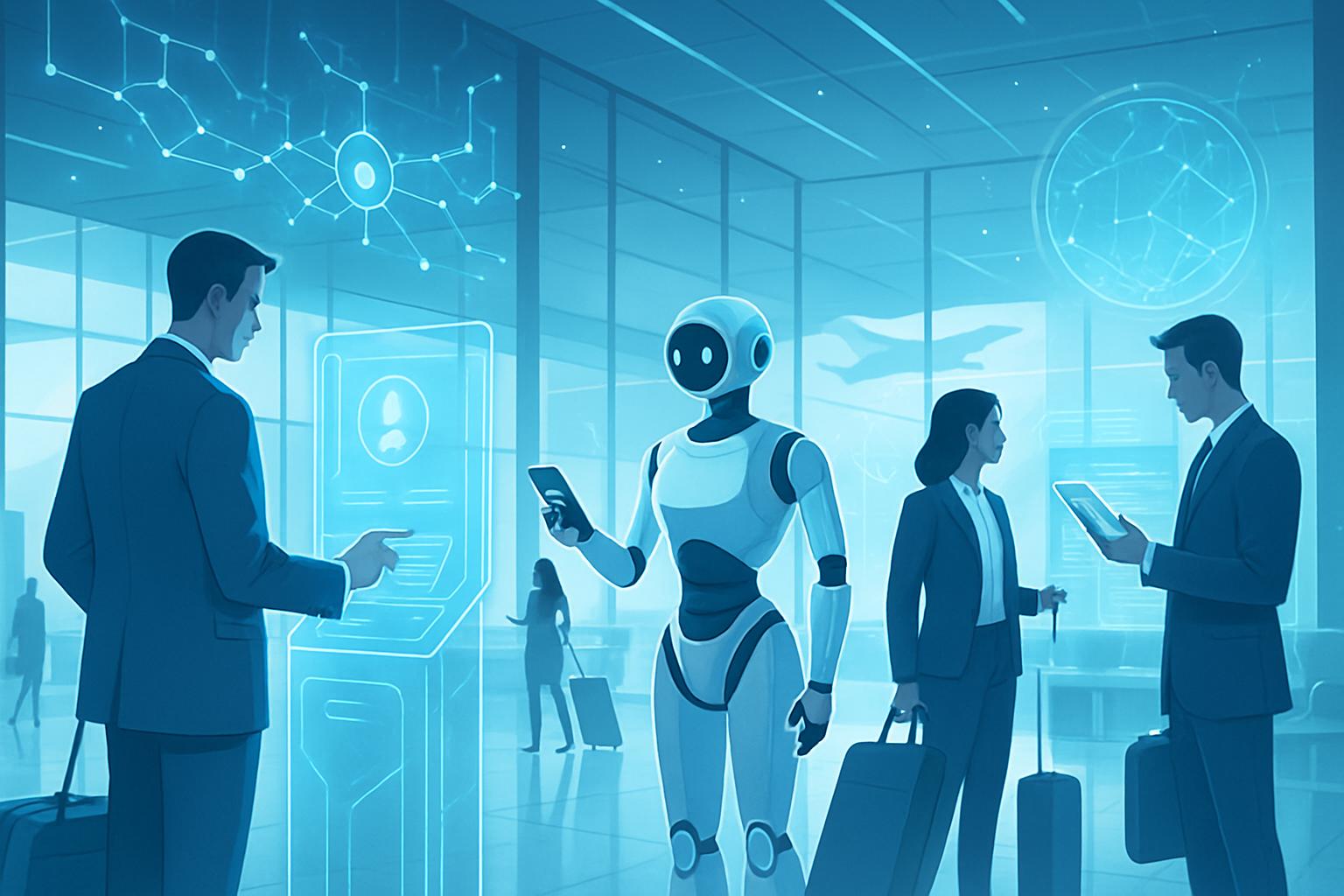
Artificial intelligence is no longer just a futuristic idea in business travel—it’s reshaping how companies manage trips, costs, and sustainability in real time. But as AI grows in influence, so do concerns around trust, privacy, and accuracy. Can businesses strike the right balance between innovation and reliability?
The changing role of AI in business travel, as covered by PhocusWire, explains how artificial intelligence is influencing both efficiency and the traveler experience in the corporate travel industry. From tools that simplify program management to new laws regulating AI, the past year has been one of noteworthy activity. A recent survey shows that more than two-thirds of corporate travel managers expect AI to either heavily impact or completely reshape the industry in the next five years, and it’s apparent the technology has already started doing both.
Companies like Altour, Amex GBT, and HRS have introduced AI-powered features to corporate travel programs. Altour now offers tools for booking and disruption management, while Amex GBT’s updates to the Egencia platform include an improved virtual agent and natural language queries for analyzing travel data. HRS has extended its efforts further with its Copilot platform, which uses large-scale language models to assist managers with adjusting hotel programs and other travel needs in real-time. What differentiates HRS is its focus on adoption, sustainability, and compliance, demonstrating that AI has applications beyond just improving bookings—it can streamline the entire structure of a corporate travel program.
However, corporations also have concerns about AI, primarily involving data security, accuracy, and reliability. Security teams are being vigilant about vendor approval processes, and experts are working to address issues like hallucinations to keep error rates as low as possible. Despite these challenges, companies and technology leaders remain hopeful, pointing to potential improvements in convenience, cost management, and sustainability standards.
Why It Matters
This article emphasizes the dynamic mix of technological progress and operational challenges developing in corporate travel. Tools like HRS’s Copilot and the upgraded Egencia platform illustrate how AI is becoming a key part of managing complex travel needs—tools that can not only centralize expenses but also predict issues and suggest improvements based on real-time data. These changes reflect a future where AI could benefit not just individual employee experience but also broader organizational goals around compliance and sustainability.
Interestingly, the underlying effort to adopt AI isn’t all straightforward. For these tools to truly succeed, they need to integrate into existing platforms smoothly, maintain user trust, and provide consistent outcomes. With companies taking steps like localizing their data models and conducting rigorous testing, it’s clear that development isn’t just about technology, but also about building long-term solutions that prioritize privacy and reliability.
Benefits
- AI can greatly reduce the time required for procurement and program optimization, cutting manual effort for managers.
- By using real-time data, it helps organizations save costs while aligning with policies such as sustainability goals and vendor compliance.
- With natural language tools, AI simplifies analysis and allows users without technical expertise to act on insights.
Concerns
- Accuracy remains a notable challenge, as AI-generated errors can affect traveler trust and program efficiency.
- Data privacy and security are significant hurdles, particularly when sensitive corporate information is involved.
- The slow pace of adoption due to lengthy approval processes and limited understanding of AI capabilities among some stakeholders could delay or restrict progress.
Possible Business Use Cases
- Create a platform that integrates AI-driven travel planning with sustainability reporting, helping companies track emissions and adjust policies seamlessly.
- Develop AI-based predictive tools to assist travelers with disruption management, such as rebooking flights or accommodations in real-time.
- Offer a subscription-based service for small-to-medium businesses to outsource AI-optimized corporate travel management without requiring in-house expertise.
As AI evolves further, it’s becoming an increasingly practical tool in business travel, offering clear benefits like cost-efficiency, convenience, and sustainability enforcement. However, the success of these tools lies in how well companies address risks related to privacy, security, and accuracy. Balancing progress with caution will be the key to building the reliable AI-powered platforms of the future, particularly in industries like corporate travel, where people’s safety, time, and resources are on the line.
—
You can read the original article here.
Image Credit: GPT Image 1 / Modern.
Make your own custom style AI image with lots of cool settings!
—
I consult with clients on generative AI-infused branding, web design, and digital marketing to help them generate leads, boost sales, increase efficiency & spark creativity.
Feel free to get in touch or book a call.