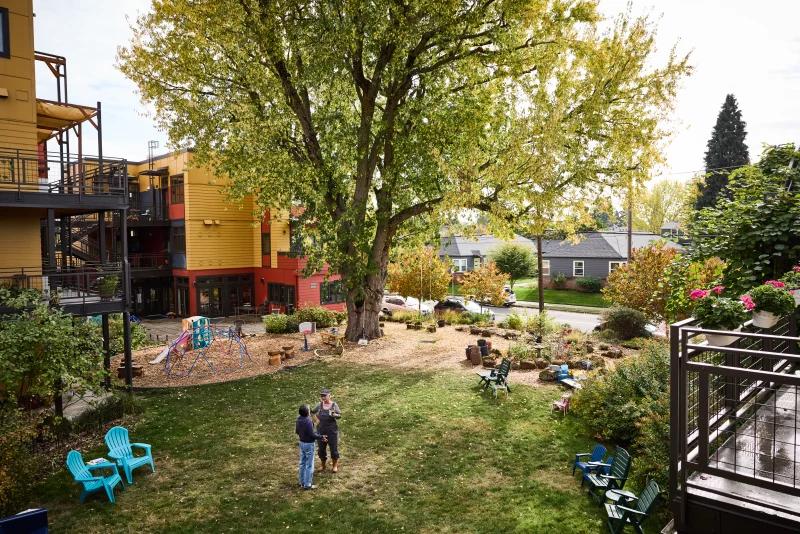
In an age of growing disconnection, our homes can either isolate us further or become sanctuaries of shared belonging. What if the key to deeper connection lies not in grand gestures, but in rethinking how we live together, starting with something as simple as reimagining our neighborhoods?
How to be not lonely? ‘Cohousing’ is an answer for some people, published by NPR, examines a creative living concept that changes the way we interact with neighbors and find support in our everyday lives. Cohousing, a form of collaborative housing where individuals maintain private homes but share common spaces and resources, has emerged as a solution to the widespread challenge of social isolation. With nearly 200 such communities across the United States, this approach offers families, retirees, and singles a chance to rebuild a sense of connection and interdependence. The article shares the experience of the Damgen family, who found comfort and support in their 30-unit community in Portland, Oregon. This change allowed them to handle the challenges of parenting with a built-in network of neighbors ready and willing to help when needed.
Originating in Denmark and introduced to the U.S. in the 1980s, cohousing communities operate on shared values of cooperation and mutual aid. These spaces encourage everything from casual interactions in shared courtyards to more structured collaboration on governance and shared chores. While the trade-offs—such as smaller living spaces, a financial buy-in, and time-intensive decision-making processes—require thoughtful commitment, residents like 73-year-old Deana Camp emphasize that the emotional security and frequent companionship are worth it. The model brings specific challenges, including navigating group dynamics and finding builders willing to work on these unconventional projects, but for those who participate, the benefits appear deeply meaningful.
Why This Concept Connects with People Today
In a society increasingly marked by separation and loneliness, particularly noticeable among parents and older adults, cohousing presents a fresh alternative. It offers a proactive way to combat the struggles of modern isolation by creating intentional micro-communities designed for mutual care. Unlike familial relationships or the fleeting connections of acquaintances, these communities form what the Damgens call a “third category” of relationships—neighbors who may not be best friends but are committed to showing up for one another. This purposeful interconnectedness responds to core human needs for belonging and cooperative living, often missing in conventional housing structures.
Additionally, for aging individuals like Deana Camp, this model protects against the emotional toll of losing loved ones. It’s a framework built not only on housing but on encouraging intergenerational engagement, reducing reliance on traditional, fragmented forms of care. Cohousing addresses a cultural gap, stepping into the void left by increasingly mobile nuclear families and isolated urban living.
The Benefits
- Strengthened social connections lead to improved mental health for individuals of all ages.
- Shared responsibilities create a more sustainable and cooperative way of living.
- Intergenerational interactions enhance empathy, understanding, and practical support between age groups.
- Parents benefit from an ad-hoc support system, easing the stress of balancing work and family obligations.
- Communities showcase a more resource-efficient living model, reducing environmental impact by sharing amenities.
Challenges
Although cohousing offers emotional and cultural benefits, it isn’t free from difficulties. The governance structure often demands significant time and energy, as residents are expected to participate in lengthy cooperative decision-making processes. From committee work to the coordination of shared tasks, the system can feel overwhelming for some. Additionally, the financial costs of building and maintaining these communities remain a barrier for many, coupled with slow timelines for construction. Finally, a lack of privacy due to shared spaces might deter individuals who want stronger boundaries.
Possible Business Use Cases
- Create modular cohousing units that can be quickly assembled, reducing construction time and cost.
- Develop a digital platform for cohousing communities to manage governance, chores, and financial contributions more efficiently.
- Design consulting services to guide traditional neighborhoods in retrofitting shared spaces and adapting hybrid cohousing principles.
The cohousing movement offers a thoughtful counterpoint to the disconnect many feel in today’s world. For parents like the Damgens, who no longer face the heavy burden of managing everything alone, and community elders like Deana Camp, who find purpose in daily interactions, these intentional communities may serve as an example for a more connected future. Despite economic and logistical challenges, the concept addresses some of the most pressing issues of our time—loneliness, family separation, and the need for sustainable living. As the model grows, balancing its trade-offs will require ongoing conversation and adjustment, but its ability to create a life shared and supported keeps the idea alive for many seeking meaningful change. If cohousing teaches us anything, it’s that the strength of a community is measured not by its size, but by its willingness to support one another through life’s challenges. Let this idea inspire discussions about how we can reshape our lives to align more closely with our deepest needs for connection and care.
—
You can read the original article here.
—
Building a world that works for everyone — through collaborative intelligence, practical solutions, and regenerative community.
Join the movement → eden.coop